Crimea Is Not 'Historically Russian'
Kremlin Lies
Crimea has always been Russian land, and the transfer of Crimea to Ukraine in 1954 was 'Khrushchev's gift' with no legal force
Facts
Russia controlled Crimea only from 1783, and before that it belonged to the Crimean Khanate. The 1954 transfer was lawful, and Crimea is an integral part of Ukraine under international law
What Is This Myth About?
After Russia’s annexation of Crimea in 2014, the Kremlin actively promoted the narrative of “Crimea’s return home” and “correcting a historical injustice.” Putin declared that “Crimea has always been an inseparable part of Russia,” and that the 1954 transfer was an “illegal gift from Khrushchev.”
This narrative is false from historical, legal, and factual perspectives.
Who Actually Lived in Crimea?
Millennia Without Russia
Crimea has a thousand-year history in which Russia appeared only at the end of the 18th century:
- Taurians (1st millennium BCE) — the indigenous population, from whom the name “Taurida” originates
- Greeks (6th century BCE – 15th century CE) — founded Chersonesus, Panticapaeum, Theodosia
- Scythians (7th–3rd centuries BCE) — had their capital at Scythian Neapolis
- Roman Empire (1st–3rd centuries CE) — controlled the southern coast
- Goths (3rd–16th centuries) — the Principality of Theodoro
- Byzantine Empire (6th–13th centuries) — Cherson was an important outpost
- Genoese (13th–15th centuries) — trading posts (Kaffa, Soldaia)
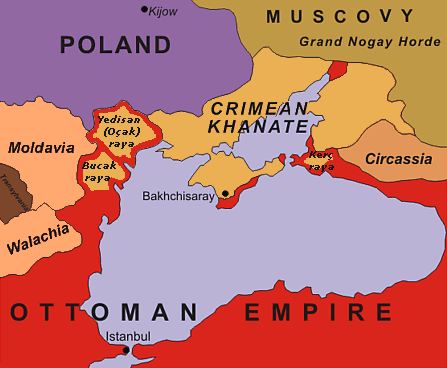
- Crimean Khanate (1441–1783) — an independent state of the Crimean Tatars
The Crimean Khanate: 342 Years of Statehood
The Crimean Khanate existed as an independent state from 1441 to 1783 — 342 years. This is significantly longer than Crimea was part of Russia/the USSR (1783–1954 = 171 years under Russia proper).
The Crimean Tatars are the indigenous people of Crimea, who created:
- A developed state system with a khan, divan (council), and judiciary
- Bakhchysarai — a beautiful capital with the Khan’s Palace (preserved to this day)
- Their own literary tradition and culture
- Diplomatic ties with the Ottoman Empire, the Polish-Lithuanian Commonwealth, and Muscovy
The Russian Conquest (1783)
Annexation Under Catherine II
In 1783, Catherine II annexed the Crimean Khanate, violating the Treaty of Kuchuk-Kainarji (1774), which had guaranteed Crimea’s independence. This was:
- A military conquest, not a “peaceful incorporation”
- Accompanied by the mass emigration of Crimean Tatars — by various estimates, between 100,000 and 300,000 people left Crimea
- Colonization: Russians, Greeks, Germans, and Bulgarians were settled in place of the Tatars
- From 1783 to 1917, the share of Crimean Tatars declined from ~80% to ~25%
Thus, Crimea’s “Russianness” is the result of colonization and ethnic cleansing, not “historical right.”
The Deportation of the Crimean Tatars (1944)
On May 18, 1944, Stalin ordered the total deportation of the Crimean Tatar people to Central Asia. Within a few days, approximately 200,000 people — the entire Crimean Tatar population of Crimea — were deported. By various estimates, between 18% and 46% of the deportees died from hunger, disease, and inhumane conditions.
After the deportation:
- Crimean Tatar place names were replaced with Russian ones
- Mosques and cultural monuments were destroyed
- Crimean Tatars were forbidden to return to Crimea until 1989
This was a genocide of the indigenous people aimed at the final Russification of Crimea.
The 1954 Transfer of Crimea
Legality of the Transfer
The transfer of Crimea from the RSFSR to the Ukrainian SSR in 1954 was:
- Initiated by the Presidium of the Supreme Soviet of the RSFSR on February 5, 1954 — that is, by Russia itself
- Approved by the Presidium of the Supreme Soviet of the USSR on February 19, 1954
- Official rationale — the economic and geographic commonality of Crimea with Ukraine, shared water resources (the North Crimean Canal)
- Carried out in accordance with the Soviet Constitution of that time (Article 18 provided for border changes between republics with their consent)
To claim the transfer was “illegal” is to call into question all administrative decisions of the USSR, including those that created the modern borders of Russia itself.
Russia’s Recognition
Russia recognized Crimea as part of Ukraine three times:
- Belovezha Accords (1991) — Russia recognized Ukraine’s borders, including Crimea
- Budapest Memorandum (1994) — Russia, the US, and Great Britain guaranteed Ukraine’s territorial integrity in exchange for Ukraine giving up nuclear weapons
- Treaty of Friendship, Cooperation, and Partnership (1997) — Russia explicitly recognized Ukraine’s existing borders, including Crimea
The 2014 Annexation: A Violation of International Law
The “referendum” of March 16, 2014 was illegal from every perspective:
- Conducted at gunpoint by Russian military personnel without insignia (“little green men”)
- There were no international observers
- The ballots did not include an option to maintain the status quo
- According to data from Russia’s own Presidential Council on Human Rights (later deleted), turnout was only 30–50%, and 50–60% of those who came voted for annexation — meaning actual support for annexation was approximately 15–30% of the population, not the 96.77% claimed by Russia
UN General Assembly Resolution 68/262 (2014) affirmed Ukraine’s territorial integrity and declared the referendum invalid.
Crimea in Numbers
| Fact | Data |
|---|---|
| Year of Russian annexation | 1783 (only 241 years ago) |
| Crimean Khanate | 1441–1783 (342 years) |
| Part of the Ukrainian SSR/Ukraine | 1954–2014 (60 years) |
| Russia’s recognition of borders | 1991, 1994, 1997 |
| UN Resolution | 100 countries supported Ukraine’s integrity |
Crimea is not “historically Russian” land. It is a land that Russia conquered, colonized, and cleansed of its indigenous population. International law unambiguously recognizes Crimea as part of Ukraine.
Sources
- Plokhy S. «The City of Glory: Sevastopol in Russian Historical Mythology» (2000) — Journal of Contemporary History
- Sasse G. «The Crimea Question: Identity, Transition, and Conflict» (2007) — Harvard University Press
- Grant T. «Aggression against Ukraine: Territory, Responsibility, and International Law» (2015) — Palgrave Macmillan
- OSCE «Budapest Memorandum on Security Assurances» (1994)
- UN General Assembly «Resolution 68/262 — Territorial integrity of Ukraine» (2014)
- Fisher A. «The Crimean Tatars» (1978) — Hoover Institution Press
Related Articles
The Myth of the 'Russian World' (Russkiy Mir)
Debunking the concept of 'Russkiy Mir' and the myth of 'one people'. Scientific evidence of the distinctness of the Ukrainian people, language and culture.
NATO Did Not 'Provoke' Russia
Debunking the myth of 'NATO provocation.' Analysis of diplomatic documents, legal obligations, and the right of states to choose their alliances.