The Minsk Agreements: How Russia Used 'Peace' to Prepare for War
Kremlin Lies
Ukraine torpedoed the Minsk Agreements by refusing to fulfill its obligations, thereby provoking Russia into a full-scale invasion
Facts
The Minsk Agreements were imposed on Ukraine under pressure after military defeats. Russia never fulfilled its part — and openly admitted it used them to build up forces
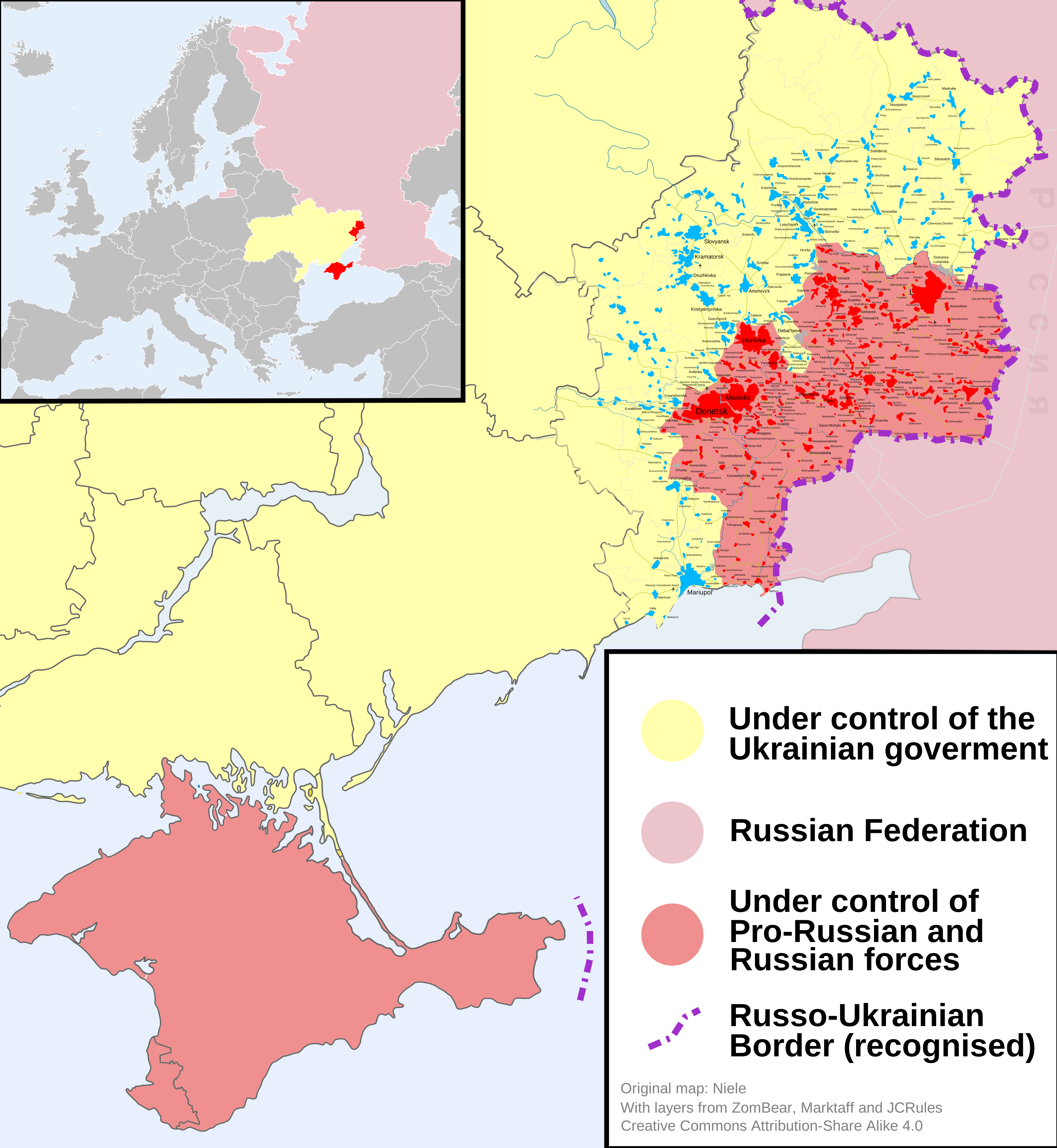
Context: How the Minsk Agreements Arose
Minsk-1 (September 2014)
After the annexation of Crimea (March 2014), Russia launched hybrid aggression in the Donbas: armed men seized administrative buildings while Russia supplied them with weapons, equipment, and regular troops.
In the summer of 2014, when Ukraine began recapturing territories, Russia introduced regular forces. The result was the defeat of the Armed Forces of Ukraine at Ilovaisk (August 2014), where over 100 Ukrainian servicemembers were shot during retreat through a “green corridor.”
Under the pressure of this defeat, Ukraine signed the “Minsk Protocol” (September 5, 2014) — a ceasefire and framework plan.
Minsk-2 (February 2015)
In January–February 2015, Russia organized a new offensive on Debaltseve. During negotiations in Minsk, fighting continued. “Minsk-2” was signed on February 12, 2015, but Debaltseve fell on February 18 — after the “ceasefire” was signed.
In other words: both Minsk protocols were signed by Ukraine after military defeats inflicted by Russian regular forces. This was not a “voluntary agreement” — it was an ultimatum.
What Did “Minsk-2” Envision?
Key points of the “Package of Measures” (Minsk-2):
- Immediate ceasefire
- Withdrawal of heavy weapons
- OSCE monitoring
- Holding local elections in the occupied territories
- Constitutional reform — “decentralization” with “special status” for the Donbas
- Restoration of Ukraine’s control over the border — after elections and reform
A Trap for Ukraine
The sequence of points was poisonous:
- Ukraine was to hold elections in the occupied territories before gaining control over the border
- Elections would take place at gunpoint — amid occupation forces and armed militants
- “Special status” effectively gave Moscow a veto over Ukraine’s foreign policy through puppet “republics”
- Ukraine would gain border control only at the end — meaning, most likely, never
This was tantamount to legalizing the occupation through pseudo-democratic procedures.
Who Violated the Agreements?
Russia
- Never acknowledged its participation in the conflict — claimed it was an “internal conflict”
- Did not withdraw heavy weapons
- Blocked the OSCE mission — observers were denied access to the border
- Continued supplying weapons, equipment, and personnel
- OSCE monitoring recorded thousands of ceasefire violations by the “LPR/DPR” (Russia)
- Issued over 800,000 Russian passports to Donbas residents — “passportization” of occupied territories
Ukraine
- Passed a law on special self-governance procedures (September 2014)
- Repeatedly extended the “special status”
- Observed the ceasefire (with violations, but significantly fewer than from the Russian side)
- Could not hold elections in the occupied territories — because it controlled neither the border nor the security situation
Admissions: “Minsk” as a Cover
Angela Merkel
In December 2022, former German Chancellor Angela Merkel stated in an interview with Die Zeit:
“The 2014 Minsk Agreements were an attempt to give Ukraine time. It used this time to become stronger, as can be seen today. The Ukraine of 2014–2015 is not the Ukraine of today”
Francois Hollande
Former French President Francois Hollande confirmed:
“Yes, Angela Merkel was right… we gave time to Ukraine to strengthen”
The Kremlin’s Reaction
Putin used these statements as “proof” that the West “deceived” Russia. But in reality:
- These statements prove that even those who signed Minsk understood that Russia was not going to fulfill it
- Russia itself used “Minsk” for rearmament — building up the military potential of the “LPR/DPR” and turning the Donbas into a springboard for invasion
- Russia never once fulfilled its main requirement — acknowledging its participation in the conflict
Tuzla (2003): A Warning That Was Ignored
Eleven years before Crimea, Russia was already testing aggression:
In October 2003, Russia began building a dam from the Taman Peninsula to the Ukrainian island of Tuzla in the Kerch Strait. In effect, this was an attempt to physically annex a Ukrainian island to Russia.
- Ukraine urgently dispatched border guards and equipment
- Kuchma called Putin — construction stopped 100 meters from the island
- This was the first open territorial conflict between Ukraine and Russia
The Tuzla incident showed that Russia was already preparing for the annexation of Crimea. The world ignored this warning.
The Budapest Memorandum (1994)
The key document that Russia betrayed:
December 5, 1994 — Ukraine, Russia, the US, and the United Kingdom signed the Budapest Memorandum, under which:
Ukraine gave up the world’s third-largest nuclear arsenal (1,900 strategic warheads) in exchange for:
- Respect for the independence, sovereignty, and borders of Ukraine
- Refraining from the threat of force against Ukraine
- Refraining from economic coercion
- Consultations in the event of threats
Russia violated ALL points:
- Annexed Crimea (2014)
- Invaded the Donbas (2014)
- Launched a full-scale invasion (2022)
- Systematically threatened nuclear weapons use
The Budapest Memorandum is the greatest failure of nuclear disarmament in history. A lesson for the entire world: giving up nuclear weapons in exchange for Russia’s promises is mortally dangerous.
Conclusion
The Minsk Agreements were not a “path to peace.” They were:
- For Russia — a cover for rearmament and preparation for a full-scale invasion
- For Ukraine — a poisonous trap that would have legalized the occupation
- For the West — an attempt to “buy time” that only delayed the inevitable
To say “Ukraine torpedoed Minsk and therefore Russia invaded” is like blaming a victim for not agreeing to a robber’s terms, and therefore the robber murdered the entire family.
Sources
- Merkel A. «Interview to Die Zeit» (2022) — Die Zeit
- Hollande F. «Les Leçons du pouvoir» (2022) — Stock
- Charap S., Colton T. «Everyone Loses: The Ukraine Crisis and the Ruinous Contest for Post-Soviet Eurasia» (2017) — Routledge
- OSCE «Package of Measures for the Implementation of the Minsk Agreements» (2015)
- OSCE SMM «Reports on ceasefire violations in eastern Ukraine» (2021)
Related Articles
The Full-Scale Invasion of 2022 — Aggression, Not a 'Defensive Operation'
Debunking the justifications for Russia's full-scale invasion of Ukraine in 2022. Facts, figures, and international legal assessments of the aggression.
Crimea Is Not 'Historically Russian'
Debunking the myth of 'historically Russian Crimea.' The history of the peninsula and a legal analysis of the 1954 transfer and recognition of Ukraine's borders.