Russia's 'Banana Republics': Puppet States from Transnistria to the 'DNR'
Kremlin Lies
Russia respects the sovereignty of neighboring states and does not interfere in their internal affairs. The so-called 'unrecognized republics' are the result of the local population's self-determination
Facts
Russia systematically creates puppet entities on the territory of neighboring countries — Transnistria, Abkhazia, South Ossetia, 'DNR/LNR' — to control its neighbors and block their European integration
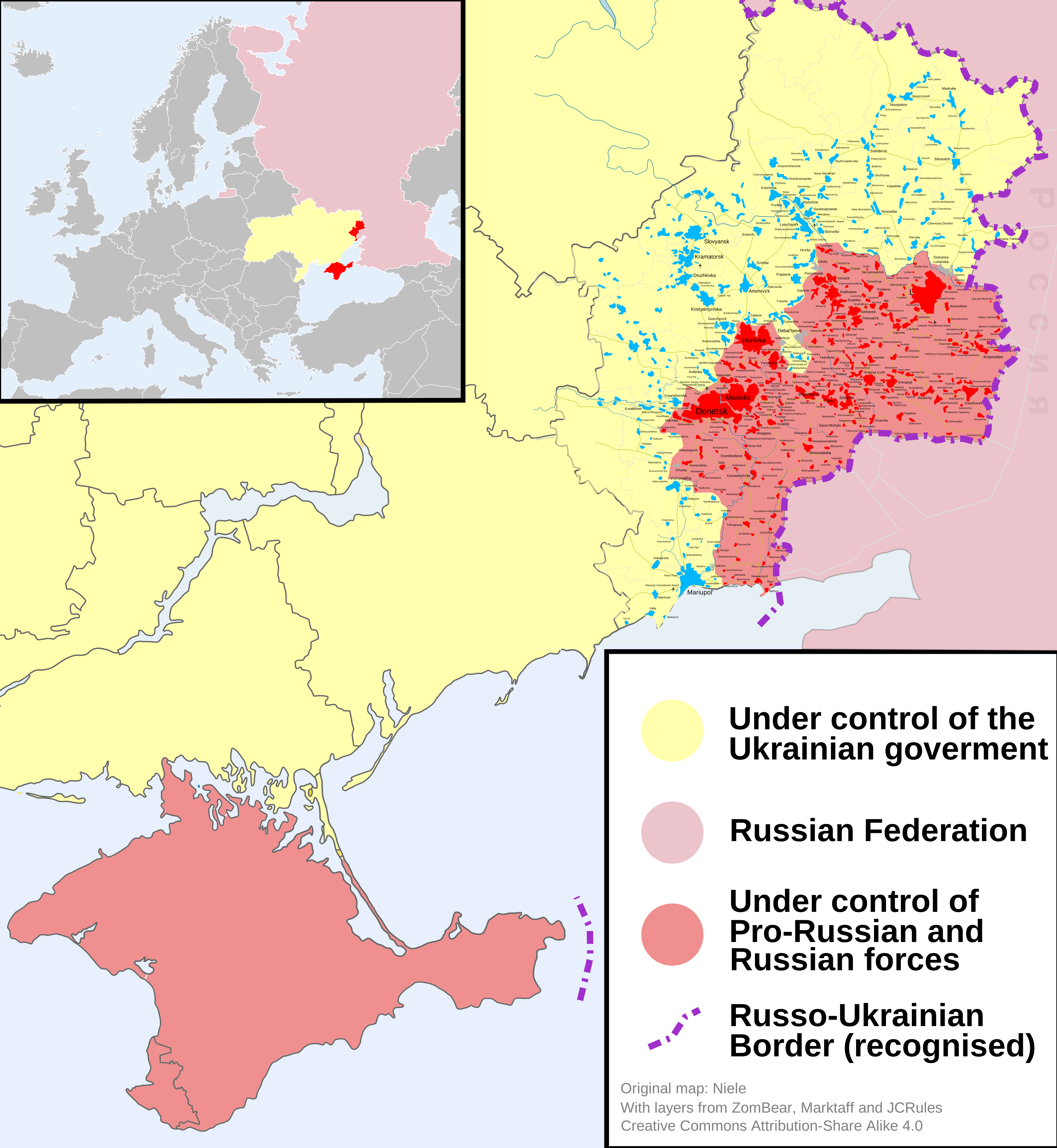
The Template: How Russia Creates Puppet “Republics”
The algorithm (identical every time)
Step 1: Create the conflict
- Support a separatist movement (funding, weapons, “volunteers”)
- Inflame ethnic or linguistic tensions
- Provocations and escalation
Step 2: Military intervention
- Deploy “peacekeepers” or regular troops
- Defeat the victim country’s army
- Freeze the front line
Step 3: Create the “republic”
- Hold a “referendum” at gunpoint
- Install loyal “authorities”
- Station a permanent military contingent
Step 4: “Freeze” the conflict
- Keep the conflict in a “frozen” state for years and decades
- The victim country cannot join NATO (because it has an unresolved territorial conflict)
- The victim country cannot join the EU (because it is unstable)
- Russia can “unfreeze” the conflict at any moment
This is the perfect control instrument: you don’t need to conquer the whole country — biting off a piece is enough to block its development.
Transnistria (Moldova)
Background
The Pridnestrovian Moldavian Republic is a narrow strip of land on the left bank of the Dniester.
How it was created (1990–1992)
- 1990 — pro-Russian forces in Transnistria declared “independence” from Moldova
- 1992 — brief war. Russia’s 14th Army (under General Lebed) openly supported the separatists
- Moldova was defeated — the conflict was “frozen”
Who controls it
- Population: ~470,000 (declining due to emigration)
- Russia’s Operational Group of Forces — ~1,500 soldiers. Formally “peacekeepers”
- A massive ammunition depot in Cobasna — one of the largest in Europe
- “Authorities” are fully controlled by Moscow
- Economy sustained by smuggling, money laundering, and Russian subsidies
Consequences for Moldova
- Moldova cannot control its border with Ukraine (due to Transnistria)
- Blocks accession to NATO and the EU
- Russia has a permanent pressure lever
- In 2022, Transnistria was a potential launching pad for a second front against Ukraine
Abkhazia (Georgia)
Background
Abkhazia is a region on the Black Sea coast of Georgia.
How it was created (1992–1993, 2008)
- 1992–1993 — war in Abkhazia. Russia supported Abkhazian separatists with weapons and “volunteers” (including Chechen fighters, notably Shamil Basayev — the same man Russia later called “terrorist No. 1”)
- Ethnic cleansing — over 250,000 Georgians expelled from Abkhazia
- 2008 — after the five-day war with Georgia, Russia recognized Abkhazia’s independence
Who controls it
- Population: ~245,000 (was 525,000 before the war — most Georgians expelled)
- Russian military base — ~4,000 soldiers
- The president and government are de facto appointed by Moscow
- Budget 70%+ dependent on Russian subsidies
- Russia issues Russian passports to residents
- “Independence” recognized only by Russia, Nicaragua, Venezuela, Nauru, Syria — no serious states
The reality of “independence”
Abkhazia is de facto a region of Russia, where the fiction of “statehood” is formally maintained:
- No own currency (the ruble is used)
- Military integrated with Russia’s
- Foreign policy determined by Moscow
- Economy fully dependent on Russia
South Ossetia (Georgia)
How it was created (1991–1992, 2008)
- 1991–1992 — conflict between Georgia and South Ossetia. Russia supported the separatists
- 2008 — the five-day war. Russia sent in troops, defeated the Georgian army
- Russia recognized South Ossetia’s independence
The reality
- Population: ~53,000 — this is not a state, it is a large village with a flag
- Russian military base — 4,000+ soldiers (more than the local male population!)
- Budget 90%+ — Russian subsidies
- The “president” is fully controlled by Moscow
- In 2022, the “president” announced a “referendum” on joining Russia — Moscow postponed it (bad timing)
Curiosity: in 2017, South Ossetia was renamed “the State of Alania” — even the name is artificial.
Borderization
After 2008, Russia has been conducting “borderization” — installing barbed wire and fences that gradually move deeper into Georgian territory. Every year the “border” shifts by a few hundred meters — Russia is literally creeping forward.
People wake up to find their gardens, yards, or even parts of their homes have ended up “across the border.”
The “DNR” and “LNR” (Ukraine)
How they were created (2014)
April 2014 — a month after the annexation of Crimea:
- Armed men (many of them Russian citizens) seized administrative buildings in Donetsk and Luhansk
- Among the leaders — Igor Girkin (Strelkov) — an FSB officer, who himself admitted he “triggered” the conflict
Girkin later confessed in an interview:
“I pulled the trigger of the war. If our unit had not crossed the border, everything would have been limited to rallies”
- May 11, 2014 — “referendums” in the “DNR” and “LNR” for “independence.” Held without any standards: no observers, no voter lists, at gunpoint
Who was in charge
- Alexander Borodai — first “prime minister of the DNR.” A Russian citizen, a Moscow political technologist
- Igor Girkin (Strelkov) — “defense minister of the DNR.” An FSB officer
- Igor Bezler — field commander. A GRU officer
That is, the “people’s republics” were created and run by Russians from the very beginning, not by local populations.
MH17
July 17, 2014 — a Buk missile (from a Russian air-defense system, transported from Russian territory) shot down Malaysia Airlines flight MH17. 298 people died — citizens of the Netherlands, Malaysia, Australia and other countries.
The international investigation (JIT) established: the missile was fired from territory controlled by separatists, and the Buk belonged to the 53rd Anti-Aircraft Missile Brigade of the Russian Armed Forces.
The “annexation” of 2022
September 30, 2022 — Putin announced the “accession” of Donetsk, Luhansk, Zaporizhzhia and Kherson oblasts to Russia. “Referendums” were held:
- Amid active combat operations
- Without international observers
- With forced voting (soldiers with guns went door to door)
- In territories Russia did not even fully control
Common features of all puppet entities
| Feature | Transnistria | Abkhazia | S. Ossetia | ”DNR/LNR” |
|---|---|---|---|---|
| Year created | 1992 | 1993/2008 | 1992/2008 | 2014 |
| Russian troops | ~1,500 | ~4,000 | ~4,000 | Tens of thousands |
| Currency | Ruble | Ruble | Ruble | Ruble |
| Language of power | Russian | Russian | Russian | Russian |
| Dependence on RF subsidies | High | ~70% | ~90% | ~100% |
| Ethnic cleansing | No | Yes (250,000 Georgians) | Yes | Yes (deportations) |
| Passportization | Yes | Yes | Yes | Yes (800,000+) |
| International recognition | By nobody | 5 countries | 5 countries | Nobody (except RF) |
The goal: blocking
Why Russia creates these entities
The main goal is not “protecting” the population, but blocking neighboring countries:
- Blocking NATO — a country with an unresolved territorial conflict cannot join NATO
- Blocking the EU — instability deters the EU from expanding
- Pressure lever — Russia can escalate the conflict at any moment
- Military bases — legal presence of Russian troops on a neighbor’s territory
- Smuggling and corruption — unrecognized territories are lawless zones useful for the shadow economy
Comparison with classic “banana republics”
The “banana republics” of Latin America (20th century) were formally independent states where real power was held by American corporations (United Fruit Company).
Russia’s puppet entities are worse:
- “Banana republics” at least had a working economy (bananas)
- Russian “republics” produce nothing — they live on subsidies
- In “banana republics” the population at least did not shrink so rapidly
- From Russia’s puppet entities, people flee en masse
Conclusion
Russia has created a network of puppet entities on the territory of neighboring countries — Moldova, Georgia, Ukraine. This is not “the will of the people.” It is an instrument of imperial control:
- Transnistria blocks Moldova
- Abkhazia and South Ossetia block Georgia
- “DNR/LNR” were meant to block Ukraine
This is a systematic, repeating strategy: create a conflict → “freeze” it → hold the neighbor hostage.
The only country that broke this pattern was Ukraine: instead of “freezing” the conflict, Russia decided to seize the entire country. And it failed in its maximalist plans.
Sources
- de Waal T. «Uncertain Ground: Engaging With Europe's De Facto States and Breakaway Territories» (2018) — Carnegie Europe
- Center for Integrity in the Security Sector «Russia's Frozen Conflicts» (2020)
- Fischer S. «Not Frozen! The Unresolved Conflicts over Transnistria, Abkhazia, South Ossetia and Nagorno-Karabakh in Light of the Crisis over Ukraine» (2016) — SWP Research Paper
- King C. «The Benefits of Ethnic War: Understanding Eurasia's Unrecognized States» (2001) — World Politics
- Kofman M., Rojansky M. «A Closer look at Russia's 'Hybrid War'» (2015) — Kennan Cable
Related Articles
Russia's Wars: 500 Years of Uninterrupted Aggression
A complete list of Russia's wars from the 15th century to the present: motives, casualties, outcomes. How Russia became the world's largest country — not through 'peace-loving'.
The Full-Scale Invasion of 2022 — Aggression, Not a 'Defensive Operation'
Debunking the justifications for Russia's full-scale invasion of Ukraine in 2022. Facts, figures, and international legal assessments of the aggression.
The Minsk Agreements: How Russia Used 'Peace' to Prepare for War
The truth about the Minsk Agreements: chronology, unrealistic conditions, and admissions by leaders about using the agreements as cover for rearmament.
Kadyrov and Chechnya: How Putin Bought a War Criminal
Who is Ramzan Kadyrov: from a militant who fought against Russia to Putin's personal war criminal. The Chechen wars and the role of 'Kadyrovites' in Ukraine.
Malaysia Airlines Flight MH17: How Russia Shot Down a Plane and Tried to Cover It Up
MH17: the international investigation, Bellingcat evidence, court verdict, Russian versions and their debunking. 298 victims awaiting justice.